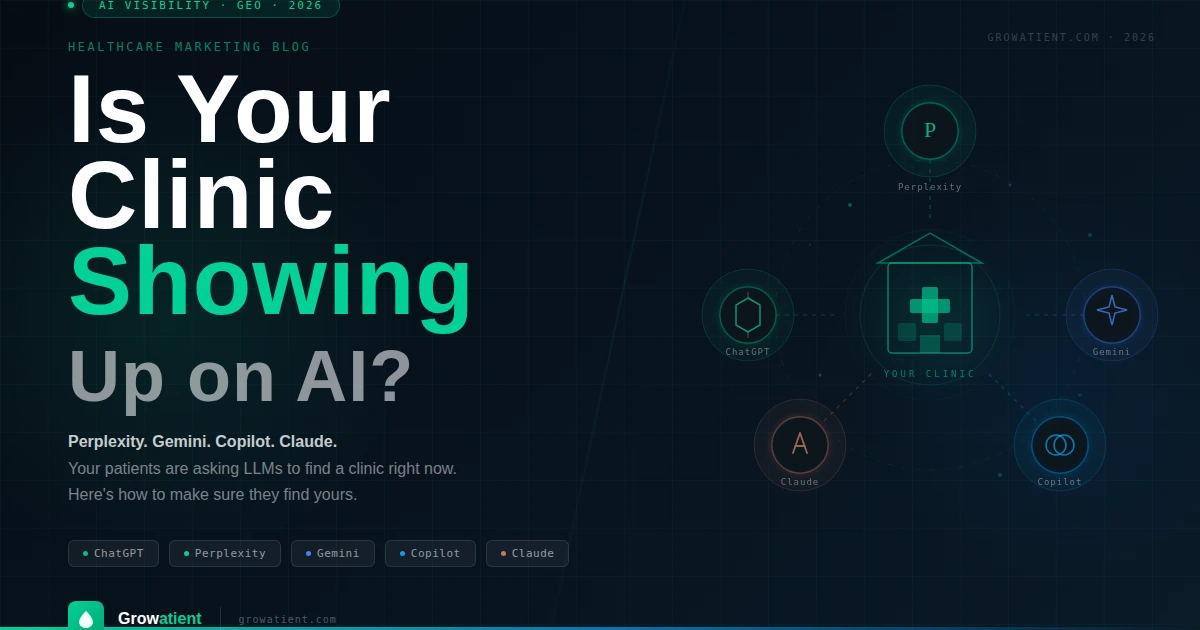
Is Your Clinic Showing Up on AI?
Last Saturday night, a patient in your city opened Perplexity AI and typed: “best urgent care clinic near me that takes walk-ins.” It was 11:03 PM. They weren’t scrolling through ten blue links. They weren’t calling anyone. They wanted one clear answer, right now — from an AI that felt like it actually knew.
Perplexity gave them three clinic names with a short explanation for each. Yours wasn’t there.
By Monday morning, that patient had already booked elsewhere at a clinic with a simpler website and a less experienced team. The difference had nothing to do with quality of care. It came down to one thing: that clinic had made itself readable, trustworthy, and citable to the AI tools patients are now using every day.
This blog tells you exactly what those AI tools are, why they matter for your clinic, and the five things you can do right now to show up in their answers.
| 230M+
health questions asked on LLMs weekly |
69%
of health searches end without a site visit |
4.4x
higher conversion from AI-referred patients |
The AI Tools Your Patients Are Already Using to Find Clinics
When most people hear “AI search,” they think of one platform. But your patients aren’t loyal to a single tool. They use whichever one they have open, whichever their phone suggests, whichever their colleague mentioned last week. And each one works differently which means getting visibility on all of them requires a deliberate strategy, not a single fix.
Here’s a quick breakdown of the main LLMs (Large Language Models) that are actively influencing patient decisions in 2026:
| LLM Platform |
How It Finds Clinics |
Key Trust Signal |
Pull From |
| ChatGPT (GPT-4o) |
Training data + live web search |
E-E-A-T content, author credentials |
Web, Yelp, directories |
| Perplexity AI |
Real-time web crawl, 15 citations/answer |
Directory consistency, Yelp, Zocdoc |
Healthgrades, Vitals, Yelp |
| Google Gemini / AI Overviews |
Google index + structured data |
Schema markup, GMB activity |
Google Business Profile |
| Microsoft Copilot |
Bing index + web search |
Bing Places, consistent NAP |
Bing Places, directories |
| Claude (Anthropic) |
Training data + web tools |
Authoritative content, citations |
Web, reputable sources |
The practical takeaway: there is no single platform to optimize for. A patient might ask Perplexity in the morning, use Google’s AI Overviews at lunch, and ask Copilot in the evening. If your clinic isn’t structured to be found across all of them, you’re losing patients at every touch point and you won’t even know it’s happening.
Your patients aren’t loyal to one AI. Your visibility strategy can’t be either.
Why Most Clinics Are Invisible to LLMs And Have No Idea
This is the part most clinic owners find uncomfortable to hear: AI tools don’t care how good your clinic actually is. They can’t walk through your door, feel the warmth of your front desk, or read the notes from a decade of patient outcomes. They can only evaluate what’s structured, consistent, and citable across the open internet.
Which means a newer clinic with a tightly structured website and consistent directory listings gets recommended ahead of a 15-year-old practice with genuine expertise simply because the AI can verify one and not the other.
These are the most common visibility gaps we see when we audit clinic websites:
- Inconsistent clinic name across directories even small differences like “&” vs “and” register as separate entities to AI models
- Service pages that describe what you do but don’t answer the questions patients actually type into AI tools
- No schema markup, the backend code that tells LLMs what kind of clinic you are, who your doctors are, and where you’re located
- Author-less blog content – AI tools heavily weight content tied to named, credentialed professionals
- Review gaps – a clinic with no recent reviews looks inactive to both patients and AI systems
| A pattern we see repeatedly:
A clinic with 15 years of experience and five-star patient care gets completely skipped by AI tools. A two-year-old competitor with a well-structured site, consistent directory presence, and regular Google reviews gets recommended first. The older clinic had the better reputation. The newer one had better AI visibility. In 2026, reputation alone does not win the recommendation. |
5 Things That Make LLMs Actually Recommend Your Clinic
These aren’t technical hacks. They’re structural changes – the kind that take a few weeks to implement properly but then work quietly in the background, building your AI visibility month after month.
-
Make Your Clinic’s Identity Consistent Everywhere
Every major LLM cross-references your clinic’s information across multiple sources before recommending it. Perplexity pulls from 15 different sources per healthcare answer on average. Google’s AI Overviews lean on structured data and your Google Business Profile. Copilot uses Bing Places and third-party directories.
If your clinic appears as “City Health Clinic” on your website, “City Health & Wellness” on Google Maps, and “CHC” on Healthgrades, the AI reads those as three different unverified entities — and recommends none of them.
Start here: make sure your clinic name, address, and phone number are character-for-character identical across:
- Google Business Profile – update it at least once a month, not once a quarter
- Healthgrades, Practo, Zocdoc, and Vitals – full profiles, not just claimed listings
- Yelp -Perplexity has a direct data partnership with them, so this one matters more than most clinics realise
- Bing Places – often forgotten, critical for Copilot visibility
- Your own website footer
-
Add Schema Markup – Let AI Read You in Its Own Language
Schema markup is structured code added to your website’s backend that tells AI systems exactly what your clinic is: your specialty, your location, your doctors, the conditions you treat, and your opening hours. Think of it as a translation layer between your website and every LLM simultaneously.
Without it, AI tools have to guess what your clinic does based on how your pages read. With it, they know and they can confidently cite you in their answers.
The most important schema types for clinics:
- MedicalOrganization — clinic type, specialties, and accreditations
- Physician — individual provider names, credentials, and specialties
- FAQPage — structured Q&A content that LLMs can pull directly into answers
- LocalBusiness — address, phone, hours, and map data
Most clinic websites have zero schema markup. Adding even the basics puts you ahead of the majority of your local competitors overnight.
-
Write Content the Way Patients Actually Talk to AI
There’s a specific way patients phrase questions to LLMs and it’s completely different from how clinics write about themselves on their websites. Clinics write: “We offer comprehensive primary care services with a patient-centred approach.” Patients ask: “Is there a GP near me who can see me today without a referral?”
LLMs are trained on natural language. They surface content that directly answers the questions people are actually typing. A well-written FAQ page covering the ten questions your front desk gets every single week does more for your AI visibility than three polished service pages full of clinical terminology.
Write for the patient at their kitchen table at 10 PM asking an AI for help. Not for a brochure that sits in your waiting room.
Practical tip: go through your last month of patient enquiries. Pick the ten most common questions. Write honest, direct answers in plain language. Publish them as a FAQ page. That content is exactly what LLMs are looking for when a patient asks a similar question.
-
Build E-E-A-T Signals That AI Can Actually Verify
E-E-A-T — Experience, Expertise, Authoritativeness, Trustworthiness is the framework that underpins how both Google and most LLMs decide whether a source is worth citing. For clinics, building these signals means making your expertise visible in formats that AI can read and verify.
- Every blog post and service page should have a named author with their credentials listed
- Link author bios to their professional profiles – LinkedIn, Doximity, NMC or GMC registration where relevant
- Add a “Last Reviewed” or “Last Updated” date to any clinical content you publish – recency is a ranking signal for LLMs
- Reference credible sources in your content – government health guidelines, peer-reviewed research, established medical bodies
A three-year-old clinic with a clear author bio, cited sources, and regularly updated content can appear more authoritative to an LLM than a practice with 20 years of experience and no visible credentials on their website. It is not fair. But it is how the system works and it is fixable.
-
Build a Consistent Review Cadence – Not a Burst Strategy
Thirty Google reviews in a single week, followed by nothing for five months, is a red flag to AI systems not a trust signal. LLMs read review patterns the way a human would: a steady stream of recent, detailed reviews signals an active, reliable clinic. A sudden spike followed by silence suggests something off.
Set up a simple automated system – a text or email that goes to every patient 24 hours after their appointment with a direct link to your Google review page. Five or six genuine reviews per month, every month, builds more credibility across LLMs than fifty reviews in a burst campaign. Consistency is the entire point.
The Window Is Still Open But It Is Closing
Here is the honest reality of where this sits in 2026.
Most clinic marketing is still built around traditional SEO: getting to page one of Google, running paid ads, collecting backlinks. That still matters. But the clinics investing in LLM visibility right now are operating in a space with almost zero local competition. Your competitor almost certainly hasn’t thought about this yet.
That is your advantage and it has a shelf life. Research shows that structured GEO (Generative Engine Optimisation) strategy can increase a clinic’s visibility in AI-generated answers by up to 40%. The clinics seeing those gains today are not the biggest or the best-funded. They are the ones who moved first.
In 12 months, when every agency is talking about LLM optimisation, the early movers will already own the recommendations. Everyone else will be paying to break into a space that’s been claimed.
| 40%
boost in LLM visibility with structured GEO strategy |
14–21
days to first measurable AI visibility gains |
25%
predicted drop in traditional search traffic by end of 2026 |
What to Do This Week
You don’t need to overhaul your entire digital presence overnight. Start with these five actions — in this order:
- Run your own AI visibility check. Open Perplexity, Gemini, and Google’s AI Overviews. Type the search your ideal patient would use — “[your specialty] clinic in [your city].” See who comes up. See who doesn’t. That result will tell you everything you need to know about urgency.
- Audit your directory consistency. Search your clinic name across Google Maps, Healthgrades, Yelp, and Practo. Compare what you find. Fix any inconsistencies in name, address, or phone number — even small ones. This is a quick win with real, measurable impact.
- Write one FAQ page this week. Pick the five questions your front desk gets asked most. Write honest, plain-language answers. Publish it on your website. This alone can meaningfully shift how LLMs read and surface your clinic.
- Set up an automated review reminder. A simple text message 24 hours after every appointment, with a direct link to your Google review page. Low effort. High long-term return. Consistent reviews across months is exactly what LLMs reward.
- Get a proper AI visibility audit. Not a generic SEO report. A review that specifically looks at how each major LLM reads your clinic — what they know about you, what they can’t verify, and what’s preventing you from being recommended. We do this for free.
Find Out If AI Would Recommend Your Clinic
We run free LLM visibility audits for clinics. No pitch. Just a clear picture of how AI tools see your clinic right now and what it would take to change that.
→ growatient.com/grow-with-usHelpful external resources
See how AI tools read your clinic
Growatient can audit your AI visibility, structured content, and clinic search footprint.
Request an AI visibility audit